
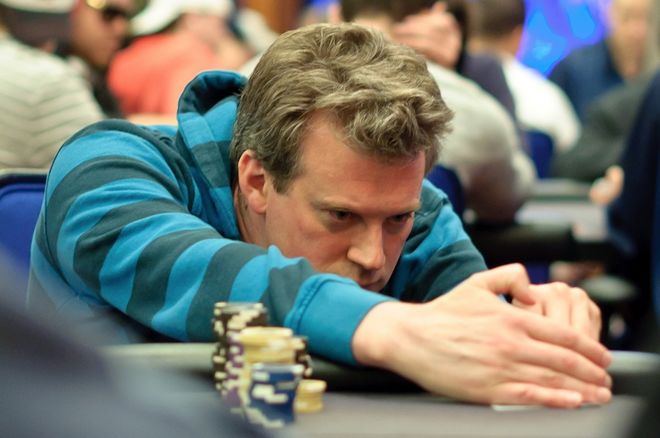
Last week I STARTED to explain a hand that offered an excellent chance to speak about how you can take into consideration your individual range of hands (versus your opponent's range). Let's recap...
I had gone to beautiful Killarney, Ireland to play a poker tournament, the hot World Poker Tour National event. Before we'd reached the cash I had a stack of nineteen big blinds once I open-raised 2x from the button with 
 -offsuit. I USED TO BE called by the large blind (who had me covered).
We both checked a 

 flop, then saw an offsuit
  turn. My opponent bet 60% of the pot (2.5 big blinds), and that i called.
The river card? An offsuit  , making the board . My opponent checked.
I decided to bet small. With those hands we wish to bet, we must always bet small because we've only a few bluffs in this board. Again, let's cope with our own range here.
What calls the turn that wishes to bluff this river?  ?
?  ? While there are some hands that may decide to bluff, most non-
 hands in my range will just wish to check and take a showdown. At the other hand, we will be able to have every kind of and
  hands as well.
I bet slightly below two big blinds into the pot of eleven BBs. Our opponent then check-raised enough to place me all in for my last 12 big blinds.
Easy call, right? Or is it?
Looking for clues in our own range (continued)
Well, once we consider that our opponent would have (or must have) three-bet before the flop (remember, effective stacks to begin the hand were 19 BBs), then yes, the decision is simple. But this was live poker and never everyone plays "standard" preflop. Let us take a look at the case where our opponent has in his preflop range.
In this river situation, the density of straights my turn-calling range makes in this particular card is high enough to create a little bit a dilemma when our opponent takes the strongest lines. The highest of my range is massive. If we define it as and better, then I have...
We can add to boot six combinations of and 4 of -suited (I fold  and worse to the turn bet). That adds as much as a variety including 106 combos of hands.
At least two things follow from this examination of our own range.
First, it's suicidal for the large unaware of bluff against a betting range that incorporates 106 combinations of or better straights. (So should we actually be calling to chop, then?)
Second, if I fold all my bare hands, I'M folding an excessive amount of of the highest of my range, from an exploitative perspective. But when I fold none of my hands, IT'S NOT THAT I AM folding often enough.
We could call these 106 combinations the "clue range" — the set of hands equal in strength to my hand that, when counted, guides our play.
When we realize our "clue range" is large, we should always be capable of fold some amount of it to an opponent's strongest lines (and to the worst prices he can lay us). But when we work out the "clue range" is small, then we should always consider our hand “too far up our range to fold” (because the kids say these days).
What hands in our range are we able to fold?
We have 16 combinations of that we're never folding, but how are we able to determine which hands to fold on this situation? Don't all of them look kind of the same?
Well, if we call all 90 remaining combinations, we're calling an excessive amount of relative to our worth. If we fold all 90, my opponent should check-raise all in whenever in this river with any bluff candidate, because we can be folding too often.
I think we really should not be value betting too often here. But shall we say we value bet only (because it blocks ), then bluff in equal proportion to our bet size. We laid our opponent 7-to-1, so we should always have one bluff for each seven value bets. Because we've about 122 value bets, we must always have about 17 bluffs.
Then our opponent moves all in, laying us 12 big blinds to win 27.5 big blinds. If we're playing at an equilibrium, we should always call 69.6% of the time. If we glance back at our betting range, we will be able to take our 139 betting combinations and multiply it by 0.696 = 98. So we should always call 98 combinations and fold 41. That implies folding 17 bluffs and 16 combinations of and eight combinations of . So indeed, we need to fold some .
The math shakes out similarly if we check back all as I THINK we should always. Then we're bluffing 15 combinations and therefore betting 121, and thus want to call 84 combinations. If we fold our 15 bluffs, we need to get a hold of a whopping 22 combinations of with which to fold the river. Because we've 90 combinations of that are not , that is basically 25% of our hands we're folding to the check-raise!
I think and are good hands to name with because they block the hands our opponent is in all probability changing into bluffs. Meanwhile is a great hand to fold as it doesn't block those hands whatsoever.
I also think might be a really perfect hand to fold a few of the remaining hands because we had a higher hand with on an earlier street than the entire other combinations. Poker players sometimes be afflicted by what I call “acting upon residual value.” That they had a couple and a flush draw at the turn, so that they overvalue said pair at the river when the draw missed, all other things equal.
In training ourselves to improve, we must always invert this natural tendency. The pair and the flush draw at the turn must be our first priority to fold at the river, if we will be able to call with those that did not have the draw. Here, if we need to fold some hands but not the vast majority of them, then we must always choose to fold the that was strongest on previous streets. also blocks our opponent's calling range and doesn't block bluffs — being the least likely hand for him to lift of all hands.
What actually happened
You probably already guessed what actually happened. I called with my , reasoning my opponent would have three-bet preflop. And that i promptly got shown . Then I left the tournament room.
It was surprising for me to count just what number of combinations of I must have on this river spot. When taken in tandem with the truth that I'VE in my river betting range as well, I BELIEVE it's indeed suicidal for my opponent to take a look at and bluff this example in practice (though he can in theory).
Therefore, we should always give some pause and consideration to bet-folding the second one nuts — no less than probably the most time. And both theory (above) and practice (what actually happened) bears this out.
Be certain to complete your PokerNews experience by trying out an outline of our mobile and tablet apps here. Stay on top of the poker world out of your phone with our mobile iOS and Android app, or fan the flames of our iPad app for your tablet. You too can update your individual chip counts from poker tournaments around the globe with MyStack on both Android and iOS.
PokerNews.com is the world's leading poker website. Among other things, visitors will discover a daily dose of articles with the newest poker news, live reporting from tournaments, exclusive videos, podcasts and such a lot more.
PokerStars is the biggest online poker room offering the most important amount of poker games and different game variations including Texas Hold'em, Omaha and other popular poker games. By joining PokerStars you'll be able to easily learn all of the poker rules and poker strategy by playing free poker games. Join PokerStars and luxuriate in high quality online poker.

Read More... [Source: PokerNews]

No comments:
Post a Comment